GLEONites in Montreal at the ASLO-SIL 2026 Joint Meeting
By Anna Schmidt
The Association for the Sciences of Limnology and Oceanography (ASLO) – International Society of Limnology (SIL) 2026 Joint Meeting brought together aquatic science researchers from around the globe for an engaging week of science in beautiful Montreal, Canada. Many GLEON members (aka “GLEONites”) were in attendance and represented the network through various sessions, town hall discussions, and informal meet-ups.
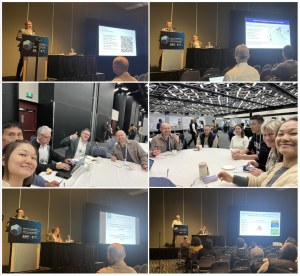
GLEONites Christopher Keneally, David Hamilton, Arianto Santoso, and Man Xiao co-chaired the AP-GLEON sessionSustaining Safe Drinking Water and Healthy Aquatic Ecosystems in the Asia-Pacific (2nd AP-GLEON). Below Man provides a nice recap of the session:
Presentations and participants in the AP-GLEON session (photo credits: Man Xiao)
“The session went very well and attracted a good audience. Although one of our scheduled speakers, Tingfeng Wu, was unfortunately unable to attend due to visa issues, we still had five excellent presentations spanning a wide range of topics relevant to AP-GLEON’s mission. The talks highlighted several key challenges facing lakes and reservoirs across the Asia-Pacific region, including climate-driven changes in aquatic ecosystems, nutrient management for cyanobacterial bloom control, remote sensing applications for bloom monitoring, cyanobacterial physiological responses to nutrient stress, the impacts of environmental extremes on harmful algal blooms, and emerging low-cost monitoring technologies for greenhouse gas observations. Together, the presentations showcased the value of combining field observations, experiments, remote sensing, and sensor-based monitoring to better understand and manage water quality threats.
David Hamilton used Tingfeng Wu’s available time slot to introduce the idea of developing a collaborative review paper on the dynamics of Asia-Pacific lakes and reservoirs. The proposal generated considerable interest and highlighted the potential for AP-GLEON to facilitate regional synthesis efforts that bring together expertise from across the network. We also took some time sitting together to brainstorm and write.” – Man Xiao, Nanjing Institute of Geography and Limnology (NIGLAS)
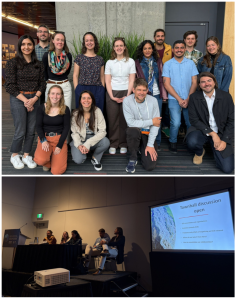
Participants in the aquatic ECR alliance town hall discussion (photo credits: Bruno Cremella and Anna Schmidt)
Other GLEON-related activities at the conference included the following:
Members of the GLEON Student Association (GSA) and Post-student Association (GPA) participated in a town hall discussion: “Towards a cross-organizational early-career aquatic science alliance.” In these conversations, Freya Olsson (GPA representative), Lisa Morales, Kirsty Forbes, and Anna Schmidt (GSA representatives) met with leaders of other student/ECR aquatic sciences organizations to discuss joint initiatives and opportunities for collaboration and crossover between networks. Participating groups included the GLEON GSA and GPA, ASLO Early Career Committee, SIL ECR Committee, AQUACOSM+ ECR Network, EFFS-EFYR (European Fresh & Young Researchers of the European Federation for Freshwater Sciences), and the Society of Canadian Aquatic Sciences Student and ECR Engagement Committee. Participants discussed pathways to create inter-organizational channels, platforms, and/or events that allow horizontal exchange of information about job opportunities, funding and financial support, career development, and collaboration requests.
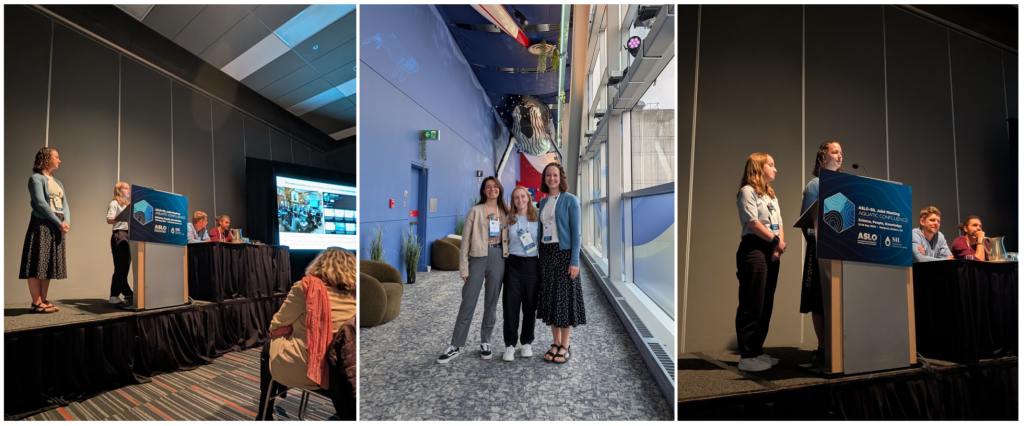
Anna Schmidt and Kirsty Forbes (GSA representatives) gave an oral presentation “Global Lake Ecological Observatory Network (GLEON) Student Association initiatives to promote student involvement in global collaborative research” in the Education & Policy session Sharing experiences among early-career researchers in aquatic science: unleashing the power of collaboration. In their talk, Anna and Kirsty gave an overview of GSA initiatives to support students leading collaborative projects under the GLEON Working Group model.
GLEON Student Association (GSA) representatives presenting on GLEON student initiatives (photo credits: Lisa Morales)
GLEONites met up for a Winter Limnology Working Group dinner and a general GLEONite evening social on Thursday evening during the conference. The social was open to GLEON members as well as others who are interested in learning more about GLEON and potentially joining the network. It was lots of fun to reunite with GLEONites and meet new folks as well!
The SIL Plankton Ecology Group (PEG) Working Group met to discuss next steps for their collaborative network of plankton ecologists. In this meeting, multiple GLEON members shared insights from the GLEON Working Group model that could be applied in the SIL PEG Working Group context. Opportunities for collaboration and cross-over between the SIL PEG Working Group and the GLEON Freshwater Biological Interactions (FBI) Working Group were discussed.
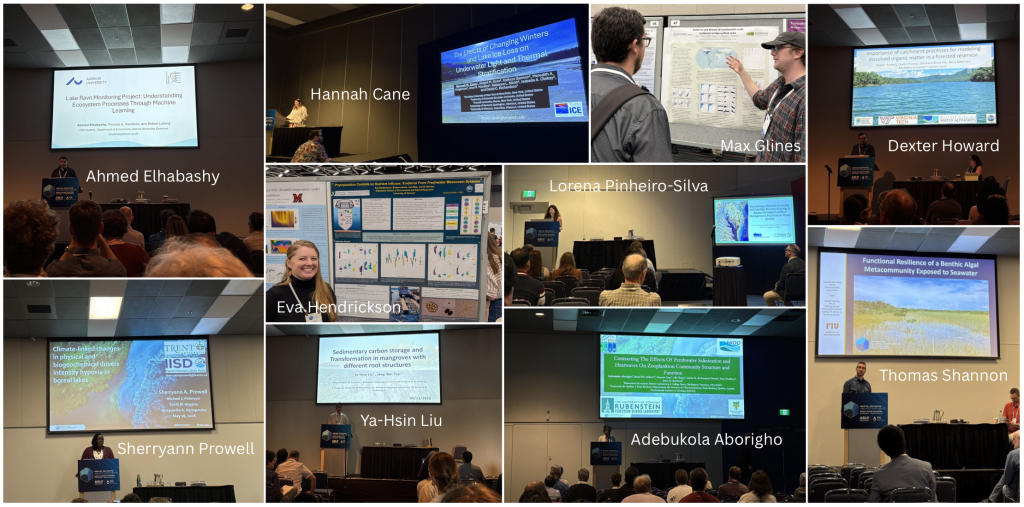
And finally, many GLEONites gave oral and poster presentations on their research, some of whom are pictured below. Great job to all of the presenters!
Subset of poster and oral presentations by GLEON students and ECRs (photo credits: Anna Schmidt)
About the author: Anna Schmidt is a Ph.D. student in the Department of Biology and Rubenstein Ecosystem Science Laboratory at the University of Vermont (Vermont, USA) and works with Dr. Jason Stockwell on zooplankton ecology research. Anna is currently Co-Chair of the GLEON Student Association (GSA).